player playlist Miranda Gomez's AP Lit Comp Blog

Thursday, February 6, 2014

Lit. Terms: List #5

parallelism: agreement in direction, tendency, or character; grammar repetition of a syntactic construction in successive sentences for rhetorical effect
parody: a humorous or satirical imitation of a serious place of literature or writing
pathos: appeal to emotions
pedantry: the habit or an instance of being a pedant, especially in the display of useless knowledge or minute observance of petty rules or details; pretension, precision
personification: the attribution of human nature or character to human animals, inanimate objects, or abstract notions, especially as a rhetorical figure
plot: storyline the plan, scheme, or main story of a literary or dramatic work, as a play, novel, or short story
poignant: keenly distressing to the feelings; heartbreaking, penetrating
point of view: the position of a narrator in relation to the story, as indicated by the narrator's outlook from which the events are depicted & by the attitude towards the characters; 1st, 2nd, & 3rd person
post modernism: any of a number of trends or movements in the arts or literature developing in the 1970's in reaction to or rejection to dogma, principles, or practices of established modernism; playful illusion, decoration or complexity

prose: the ordinary form of spoken or written language, w/o metrical structure as distinguished from poetry or verse
protagonist: the leading character, hero/heroine of a drama or other literary work
pun: the humorous use of a word or phrase so as to emphasize or suggest its different meanings or applications, or the use of works that are alike or nearly alike in sound, but in a different meaning; play on words
purpose: the reason for which something exists or done, made, used, etc.; an intended or desired result
realism: a manner of treating a subject matter that represents a careful description of everyday life, usually of the middle & lower classes; a theory of writing in which the ordinary, familiar, or mundane aspects of life are represented in a straightforward or matter-of-fact manner that is presumed to reflect life as it actually is
refrain:a phrase or verse recurring at intervals in a song or poem, especially at the end of each stanza; chorus
requiem: any musical service, hymn, or dirge for the repose of the dead
resolution: the act of determining upon an action or course of action, method, procedure, etc.
restatement: to state again or in a new way
rhetoric: (in writing or speech) the undue use of exaggeration or display; the study of a technique of using language effectively
rhetorical question: a question solely to produce an effect or use an assertion & not to elicit a reply
rising action: a related series of incidents in a literary plot that builds towards the point of greatest interest
romanticism: Romantic style or movement in literature & art, or adherence to its principles (contrasted w/ Classicism)
satire: the use of irony, sarcasm, ridicule, or the like, in exposing, denouncing, or deriding vice, folly, etc.
scansion: the metrical analysis of verse
setting: the surroundings or environment of anything

Sunday, February 2, 2014

THE TIME OF MY LIFE

When I came into the classroom I asked my classmates what I had missed the day before b/c I was absent & sick. Erica & Izamar attempted to inform me of all they knew of "free play" & Derrida. It was easy to understand it for the most part, but we had barely scratched the surface. Then we continued to discuss the most efficient ways to take notes, even though not every form of note-taking works for everyone. As we began to touch on Derrida, the substitute gave us insight of what he knew & his teachings. I came to the conclusion that Derrida's philosophy was a circumlocution of sorts. It was very dense & confusing, so I hope to have a clear understanding when we return to class this next week.

Monday, January 27, 2014

WHAT'S THE STORY?

When I think of 'Great Expectations' I ask myself, "how great are your expectations?" I constantly dwell on my mistakes & often hard on myself even though there is only so much I can do. It has always been this way for me. I feel as if there is always someone looking over my shoulder judging my actions. I become self-conscious & start to believe that what I do is not good enough. That I have to attain the ideal level of "perfection" that is almost unreal. There is no room for mistakes or fun. Pip was under these impressions as well & they drove him to be ambitious & act a certain way.

Charles Dickens wrote Great Expectations to portray the struggle of an adolescent, Pip, throughout his his childhood into adulthood. Essentially a rags to riches story. Pip's character grows exponentially throughout the novel, making mistakes & learning from them.

Examples such as:

1. Ms. Havisham & Estella act as a foil to the growth of Pip's character. They oppressed him, make him lose self-esteem, & make him believe that since he is uneducated he is worthless.
2. Throughout the novel there is a conflict between the characters. Such as Pip's sister being killed by a convict that Pip had previously aided. Pip feels guilty that he could have been responsible for the death of his sister.
3. Pip is often misunderstood & this is evocative in a way that makes you sympathize with Pip. This feeling takes you back to when you were not treated fairly & often judged because of where you came from.

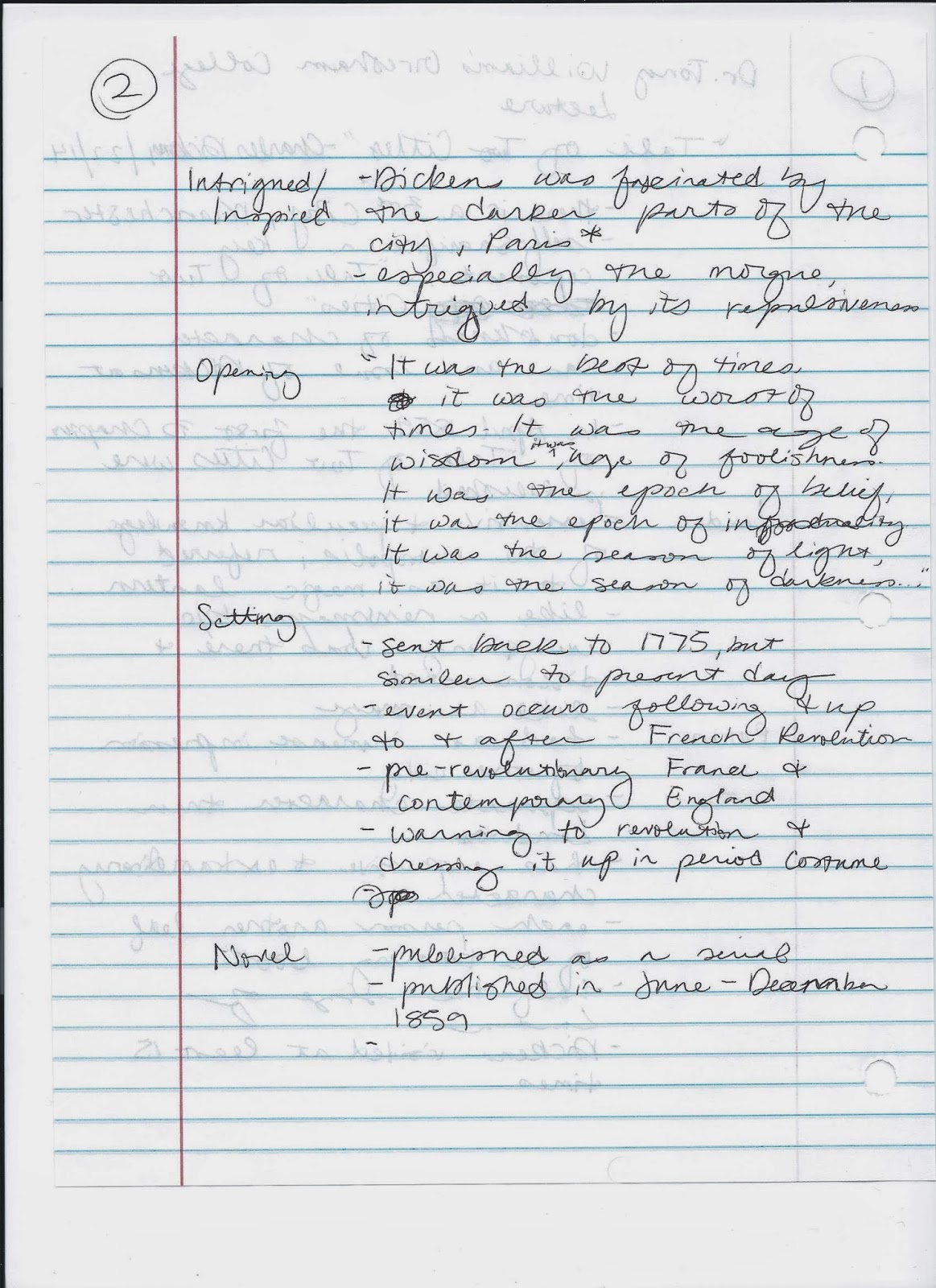
Tale of Two Cities Lecture Notes


Sunday, January 26, 2014

Lit. Terms: List #4

interior monologue: a form of stream-of-consciousness writing that represents the inner thoughts of a character


inversion: reversal of the usual or natural order of words
juxtaposition: an act or instance of placing close together or side to side, especially for comparison or contrast
lyric: (of poetry) having the form & musical quality of a song, especially the character of a song-like outpouring of the poet's own thoughts & feelings, as distinguished from epic & dramatic poetry; characterized by or expressing spontaneous, direct feelings
magic(al) realism: a style of painting & literature in which fantastic or imaginary & often unsettling images or events are depicted in a sharply detailed, realistic manner
metaphor (extended, controlling, mixed): a figure of speech in which a term or phrase is applied to something to which it is not literally applicable in order to suggest a resemblence

  • extended- a metaphor introduced & then further developed throughout all or part of a literary work, especially a poem
  • controlling- a symbolic story in which the real meaning is not directly put across the whole poem or may be a metaphor of something else; it affect's the diction & flow of a poem & normally used in political poems
  • mixed- the use in the same expression of two or more metaphors that are incongruous or illogical when combined
metonymy: a figure of speech in the use of a name of one object or concept for that of another to which it is related, or of which it is a part
ex: "the bottle" for "strong drink"
modernism: modern character, tendencies or values; adherence to or sympathy to which is modern
monologue: a form of dramatic entertainment, comedic solo, or the like by a single speaker; a prolonged talk or discourse by a single speaker, especially one dominating or monopolizing a conversation

mood: a state or quality of feeling at a particular time
motif: a recurring subject, theme, idea, etc. especially in literary, artistic, or musical work
myth: a traditional or legendary story, usually concerning some being or hero or event w/ or w/o a determinable basis or fact or a natural explanation, especially one that is concerned with deities or demigods & explains some practice, rite or phenomenon of nature
narrative: a story or account of events, experiences, of the like, either true or fictitious
narrator: a person who gives an account or tells the story of events, experiences, etc.
naturalism: a manner or technique of treating subject manner that presents, through volume of detail, deterministic view of human life & actions
novelette/novella: a brief novel or long short story; a fictional prose narrative that is longer & more complex than short story
omniscient point of view: method of storytelling in which the narrator knows the thoughts & feelings of all the characters in the story
onomatopoeia: the formation of a word, as cuckoo, meow, honk, or boom, by a imitation of a sound made by or associated w/ its referent
oxymoron: a figure of speech by which a locution produces an incongruous, seemingly self-contradictory effect as in "cruel kindness" or "to make haste slowly"
pacing:

parable: a short allegorical story deigned to illustrate or teach some truth, religious principle or moral lesson; a statement or comment that conveys a meaning indirectly by the use of comparison, analogy or the like
paradox: a statement or proposition that seems self-contradictory or absurd but in reality expresses a possible truth